layout: true class: inverse, middle
class: title
Galaxy Tool Framework Changes
John Chilton
This document describes changes to Galaxy’s tooling framework over recent releases.
16.04
Full Galaxy changelog.
Tool Profile Version (PR #1688)
Tools may (and should) now declare a profile version (e.g.
<tool profile="16.04" ...>).
This allows Galaxy to fire a warning if a tool uses features too new for the current version and allows us to migrate away from some undesirable default behaviors that were required for backward compatiblity.
set -e by default (d020522)
From the IUC best practices documentation:
“If you need to execute more than one shell command, concatenate them with a double ampersand (
&&), so that an error in a command will abort the execution of the following ones.”
The job script generated with profile 16.04+ tools will include a #set -e statement causing this behavior by default.
Older-style tools can enable this behavior by setting strict="true" on
the tool command XML block.
Using Exit Codes for Error Detection (b92074e)
Previously the default behavior was for Galaxy to ignore exit codes and declare a tool in error if issued any output on standard error. This was a regretable default behavior and so all tools were encouraged to declare special XML blocks to force the use of exit codes.
For any tool that declares a profile version of 16.04 or greater, the
default is now just to use exit codes for error detection.
Unrobust Features Removed (b92074e)
A few tool features have ben removed from tools that declare a version of 16.04 or newer.
The
interepreter=attribute oncommandblocks has been eliminated. Please use$__tool_directory__from within the tool instead.format="input"on output datasets has been eliminated, please useformat_source=to specify an exact input to derive datatype from.Disables extra output file discovery by default, tools must explicitly describe the outputs to collect with
discover_datasettags.Tools require a
versionattribute - previously an implicit default to1.0.0would be used.$param_filehas been eliminated.
Clean Working Directories
Previously, Galaxy would fill tool working directories with files related to metadata and job metric collection. Tools will no longer be executed in the same directory as these files.
This applies to all tools not just profile 16.04+ tools.
16.01
Full Galaxy changelog.
Conda Dependency Resolution (PR #1345)
<tool>
  ...
  <requirements>
    <requirement type="package" version="0.11.4">FastQC</requirement>
  </requirements>
  ...
</tool>
Dependency resolvers tell Galaxy how to translate requirements into jobs.
The Conda dependency resolver forces Galaxy to create a conda environment for the job with
FastQCat version0.11.4installed.Only dependency resolver that can be installed at runtime - great for Docker images, heterogeneous clusters, and testing tools.
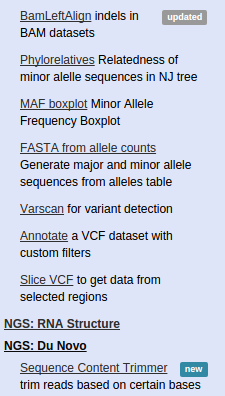
ToolBox Enhancements - Labels (PR #1012)
ToolBox Enhancements - Monitoring (PR #1398)
The Galaxy toolbox can be reloaded from the Admin interface.
Tool conf files (e.g.
tool_conf.xml) can be monitored and automatically reloaded by Galaxy.Tool conf files can now be specified as YAML (or JSON).
Process Inputs as JSON (PR #1405)
    <command>python "$__tool_directory/script.py" "$json_inputs"</command>
    <configfiles>
        <inputs name="json_inputs" />
    </configfiles>
This will produce a file referenced as $json_inputs that contains a nested
JSON structure corresponding to the tools inputs. Of limitted utility for
simple command-line tools - but complex tools with many repeats, conditional,
and nesting could potentially benefit from this.
For instance, the JBrowse
tool generates a complex JSON data structure using a configfile inside the
XML. This is a much more portable way to deal with that.
Collections
data_collectiontool parameters (params) can now specify multiplecollection_types for consumption (PR #1308).This mirrors the
formatattribute which allows a comma-separated list of potential format types.
Multiple collections can now be supplied to a
multiple="true"data parameter (PR #805).Output collections can specify a
type_sourceattribute (again mirroringformat_source) (PR #1153).
15.10
Full Galaxy changelog.
Collections
Tools may now produce explicit nested outputs PR #538. This enhances the
discover_datasetXML tag to allow this.Allow certain
outputactions on collections. PR #544.Allow
discover_datasettags to useformatinstead ofextwhen referring to datatype extensions/formats.Allow
min/maxattributes on multiple data input parameters PR #765.
Whitelist Tools that Generate HTML (PR #510)
Galaxy now contains a plain text file that contains a list of tools whose output can be trusted when rendering HTML.
15.07
Full Galaxy changelog.
Parameterized XML Macros (PR #362)
Macros now allow defining tokens to be consumed as XML attributes. For instance, the following definition
<tool>
    <expand macro="inputs" foo="hello" />
    <expand macro="inputs" foo="world" />
    <expand macro="inputs" />
    <macros>
        <xml name="inputs" token_foo="the_default">
            <inputs>@FOO@</inputs>
        </xml>
    </macros>
</tool>
would expand out as
<tool>
    <inputs>hello</inputs>
    <inputs>world</inputs>
    <inputs>the_default</inputs>
</tool>
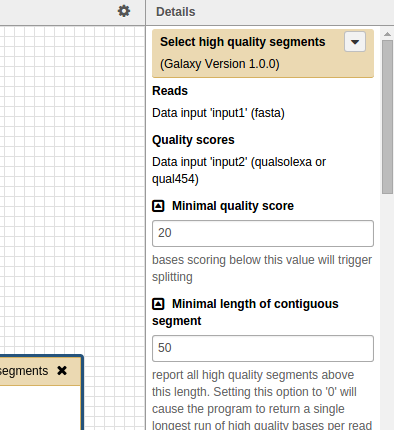
Tool Form
The workflow editor was updated to the use Galaxy’s newer frontend tool form.
Environment Variables (PR #395)
Tools may now use inputs to define environment variables that will be
set during tool execution. The new environment_variables XML block is
used to define this.
<command>
  echo "\$INTVAR"  >  $out_file1;
  echo "\$FORTEST" >> $out_file1;
</command>
<environment_variables>
  <environment_variable name="INTVAR">$inttest</environment_variable>
  <environment_variable name="FORTEST">#for i in ['m', 'o', 'o']#$i#end for#</environment_variable>
  </environment_variables>
  ...
Test tool demonstrating the use of the environment_variables tag.
Collections
Explicit output collections can now be used in workflows. (PR #311)
The
filtertag has been implemented for output dataset collections (PR #455. See the example tool output_collection_filter.xml.